Black Friday, scratch to reveal your discount, up to 30% off, today only5% off 2 items | 10% off 3+ itemsFree shipping to EuropeCustomer service 7 days a week | Excellent Google reviews
Guides · 14 min
Solitaire Ring: How to Choose the Stone, Carats, Setting and Size
Solitaire ring guide: natural or lab-grown diamond, moissanite or sapphire; shape, carats and the 4Cs; prongs and metal; ring size and ring sizer; budget.
Simatta Bijoux · 4 November 2026
1477
First known diamond engagement ring
0.2 g
The weight of one carat
6.5 mm
A 1-carat round diamond
4 or 6
Prongs: the solitaire setting
In short
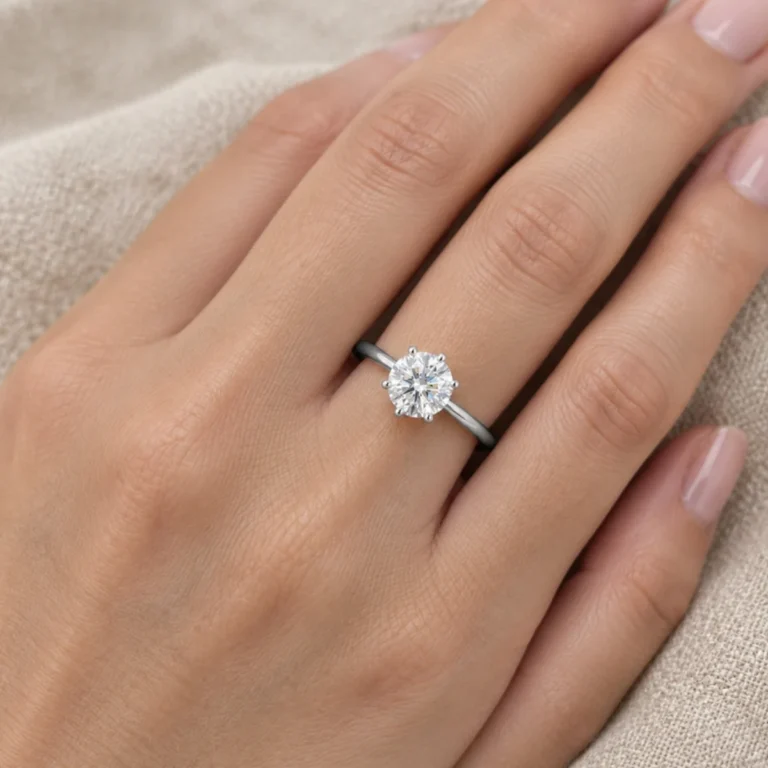
A solitaire ring carries a single stone, most often a diamond, held at the centre of the band. It is the classic engagement ring, but it is also worn every day, for its own sake. To choose it well, six things matter: the stone (natural diamond, lab-grown diamond, moissanite, sapphire…), its shape (round, oval, princess…), its weight in carats (1 carat = 0.2 g, or about 6.5 mm across for a round stone), its quality (the 4Cs: colour, clarity, cut, carat), the setting (4 or 6 prongs, bezel, in gold, platinum or silver) and the ring size, measured at the end of the day with a ring sizer.
What is a solitaire ring?
“Solitaire” means a stone set on its own. A solitaire ring is therefore a band topped with a single stone, showcased by its setting: nothing competes with it. When small stones line the band on each side, it is called a solitaire with accents (or a pavé solitaire); when three stones sit side by side, it is a trilogy ring: neither is quite a solitaire any more.
The tradition of the diamond engagement ring goes back at least to 1477, when Archduke Maximilian of Austria gave a diamond to Mary of Burgundy. The solitaire as we know it, a stone set high on six slender prongs that let the light through, became the standard at the end of the 19th century. Today it is still the most popular engagement ring, and a jewel many people also buy for themselves, for a birthday or a milestone.
Which stone for a solitaire ring?
A ring takes more knocks than any other jewel: the stone must be hard enough to keep its polish for years. Diamond, natural or lab-grown, remains the benchmark; moissanite and sapphire are also very well suited to daily wear; cubic zirconia, very cheap, scratches quickly. How they compare:
What it is
Pure carbon, formed in the Earth and mined
Hardness (Mohs)
10
Brilliance (refractive index)
2.42
Coloured flashes (“fire”)
Balanced
Everyday wear
Ideal
Certificate
GIA, IGI, HRD…
Price (order of magnitude)
€€€€€
What it is
Pure carbon, created in a laboratory: a real diamond
Hardness (Mohs)
10
Brilliance (refractive index)
2.42
Coloured flashes (“fire”)
Balanced
Everyday wear
Ideal
Certificate
IGI, GIA…
Price (order of magnitude)
€€€
What it is
Silicon carbide, created in a laboratory: a different stone
Hardness (Mohs)
9.25
Brilliance (refractive index)
2.65
Coloured flashes (“fire”)
Very strong, rainbow
Everyday wear
Very good
Certificate
Often GRA
Price (order of magnitude)
€€
What it is
Corundum, natural or lab-grown
Hardness (Mohs)
9
Brilliance (refractive index)
1.77
Coloured flashes (“fire”)
Subtle
Everyday wear
Very good
Certificate
Possible (GIA, IGI…) for a fine stone
Price (order of magnitude)
€€ (lab-grown) to €€€€ (natural)
What it is
Created in a laboratory: a diamond imitation
Hardness (Mohs)
8 to 8.5
Brilliance (refractive index)
2.15
Coloured flashes (“fire”)
Strong
Everyday wear
Not advised: scratches and clouds
Certificate
None
Price (order of magnitude)
€
Natural diamond is the traditional choice: a rare stone, formed in the Earth millions of years ago, chosen for its origin and symbolic value; it is also by far the most expensive. Lab-grown diamond has the same composition, hardness and sparkle: the two cannot be told apart with the naked eye, but it costs several times less for the same quality, which means a larger or finer stone for the same budget (see our lab-grown diamond guide). Moissanite is not a diamond: it sparkles even more, with stronger rainbow flashes, for a much gentler budget; every difference is explained in our moissanite vs diamond guide.
Sapphire brings colour: deep blue most often, but also pink, yellow or white. With a hardness of 9, it copes with daily wear; so does ruby, from the same family. Emerald, more fragile, needs a protective setting and more careful wear. Cubic zirconia, often sold simply as “CZ”, imitates diamond for a few euros: it suits a fashion ring, not a ring meant to last a lifetime.
Which stone shape to choose?
The shape (also called the “cut”) completely changes the look of the ring. Round remains the most popular, but elongated shapes have more and more fans. The main ones:
Brilliant cut
The most sparkling and the most classic, with 57 facets designed to return as much light as possible. It suits every hand and every style, and holds its resale value best.
Lengthens the finger
Almost as brilliant as a round, it looks bigger for the same weight and makes the hand look slimmer. Choose it well proportioned, without a dark area in the centre (the “bow-tie effect”).
Square and modern
A faceted square stone, very brilliant, with a more graphic style. Its four sharp corners must be protected by V-shaped prongs.
Square with soft corners
A square with rounded corners, with a vintage charm and very much in fashion. Its sparkle is soft and generous.
Step-cut rectangle
Stepped facets that act like mirrors, for an elegant Art Deco look. This cut shows everything: choose a stone of good clarity.
Pointed and slender
Drop- or boat-shaped, they lengthen the finger and look large. Their fragile points must be held by a prong.
How many carats for a solitaire ring?
The carat is a unit of weight: 1 carat = 0.2 gram. Do not confuse it with the karats of gold, which indicate the share of pure gold in the metal. What you see on the finger is the diameter of the stone. For a well-cut round diamond, the benchmarks are:
0.25
0.25 carat (about 4 mm)
A delicate stone, perfect for a slim finger or a ring stacked with others.
0.5
0.5 carat (about 5.2 mm)
A solitaire that is already clearly visible, yet discreet day to day.
1
1 carat (about 6.5 mm)
The symbolic engagement ring size, clearly visible without being imposing.
1.5
1.5 carats (about 7.4 mm)
A beautiful presence that catches the eye.
2
2 carats (about 8 mm)
A spectacular stone, especially on a slender hand.
3
3 carats (about 9 mm)
An evening solitaire, noticed from afar.
Diameter matters more than weight: a stone cut too deep weighs a lot but looks small. Moissanite, lighter than diamond, is in fact often sold in “diamond equivalent” carats, meaning the diameter of a diamond of that weight. Finally, the price of a diamond rises much faster than its weight: a 1-carat diamond costs far more than two 0.5-carat diamonds of the same quality. A weight just below a round number (0.9 instead of 1 carat) barely shows and costs less.
The 4Cs: choosing the quality of the stone
The quality of a diamond, natural or lab-grown, is described by four criteria, the “4Cs”: colour, clarity, cut and carat. They are graded on the stone’s certificate.
C
Colour
From D (perfectly colourless) to Z (tinted yellow). From D to F, the stone is colourless; from G to H, near colourless, and the difference cannot be seen once set. On yellow or rose gold, a slightly warmer colour goes unnoticed.
C
Clarity
The small internal inclusions, from FL (flawless) to I (visible inclusions). From VS2, or even SI1, they cannot be seen with the naked eye: there is no need to pay more.
C
Cut
The quality of the proportions and polish, from “Excellent” to “Poor”. It is what makes the stone sparkle: the one criterion not to compromise on.
C
Carat
The weight of the stone, which sets its visible size and weighs most on the price.
For a stone of 0.5 carat or more, ask for a certificate from a recognised laboratory (GIA, IGI or HRD for diamonds; lab-grown diamonds are most often certified by IGI). It describes the stone and often comes with a number laser-inscribed on its girdle. Moissanite is graded on the same colour and clarity scale and comes with a certificate, often GRA.
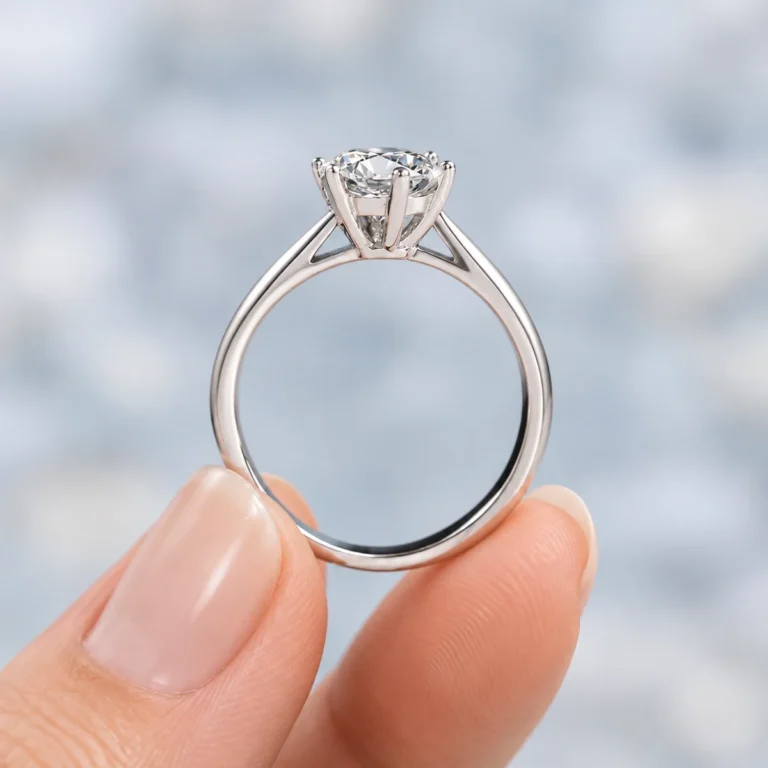
Which setting: prongs, mount and band
The setting holds the stone, protects it and shapes the outline of the ring. The main options:
F
Four prongs
Show the most stone and draw a square, beautiful on a round, an oval or a princess.
S
Six prongs
The classic solitaire setting. The stone is held more securely, looks rounder, and stays in place even if one prong is damaged.
B
Bezel setting
A thin rim of metal surrounds the whole stone. Modern and very protective, ideal for active hands, it lets a little less light in.
H
High or low setting
A high stone sparkles more and lets a wedding band slide underneath; a low stone catches less on clothes and hair.
P
Plain, pavé or twisted band
A plain band puts the stone centre stage; a pavé band of small stones adds sparkle; a twisted or intertwined band adds movement. Allow 1.8 to 2.5 mm in width for a fine solitaire.
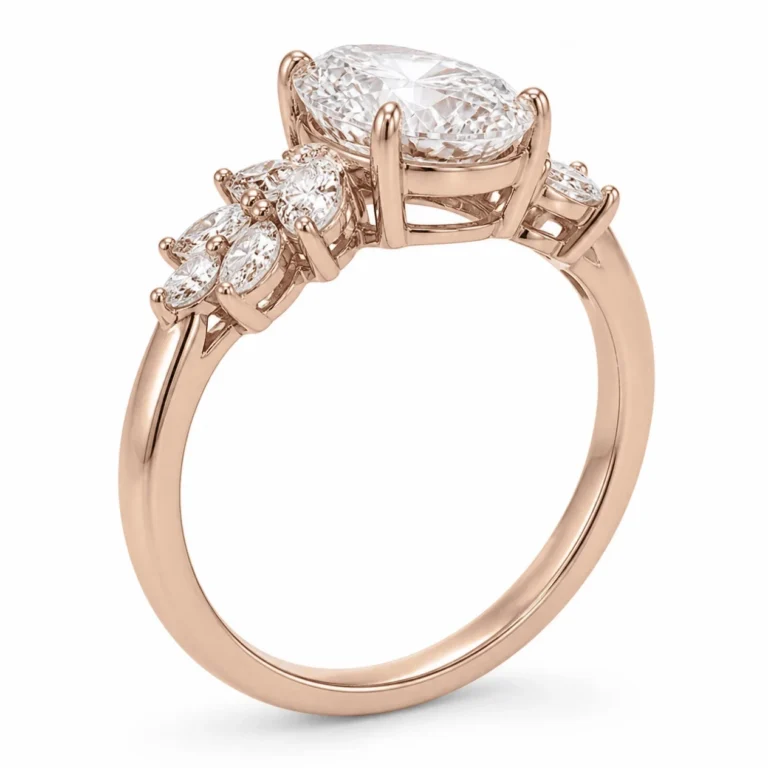
Gold, platinum or silver: which metal for a solitaire ring?
For a ring worn for a lifetime, gold is the most common choice: 18K (75% gold) for the richest colour, 14K (58.5%) for a more scratch-resistant ring, 9K (37.5%) for a gentler budget. It comes in yellow, rose and white; white gold is plated with rhodium, which needs renewing from time to time. Platinum, naturally white, very dense and hypoallergenic, is the most durable metal, but also the most expensive. 925 sterling silver, softer and more affordable, suits a fashion ring or a moissanite, preferably rhodium-plated so it does not tarnish. Gold plating and steel are for fashion jewellery. Everything is explained in our 9K, 14K or 18K gold guide.
The colour of the metal also changes the colour of the stone: white gold and platinum enhance the whiteness of a colourless diamond; yellow and rose gold warm the whole ring and flatter slightly tinted stones. If a wedding band is to follow, choose the same metal for both rings: they will wear in the same way.
What ring size? Measuring your finger properly
In France and in much of Europe, a ring size is its inner circumference in millimetres: a size 52 ring measures 52 mm around. Women’s sizes most often range from 48 to 58 (52 to 54 being the most common), men’s from 58 to 66. Other countries use other scales: French size 52 is about a US 6 or a UK L½, 54 about a US 7 or UK N½, 57 about a US 8 or UK P½. Three ways to find yours:
A
A ring sizer
A set of rings in every size, in metal or plastic, available from a jeweller or online. It is the most reliable method.
A
A ring you already wear
Measure its inner diameter and multiply it by 3.14 (a 16.5 mm diameter gives a size 52). It must be worn on the same finger, as the right hand is often slightly larger.
A
A piece of string or a strip of paper
Wrapped around the finger, then measured flat. Handy, but less accurate: add half a size if in doubt.
Measure at the end of the day, at a normal temperature: fingers swell in the heat and shrink in the cold. The ring should slide over the knuckle with slight resistance and not spin on its own. For a wide band (over 5 mm), go up half a size or a full size. For a surprise proposal, discreetly borrow a ring she wears on her ring finger, or ask someone close to her.
A gold or silver ring with a plain band can usually be made one or two sizes larger or smaller by a jeweller; a fully pavé or twisted band, much less easily.
What budget for a solitaire ring?
There is no right amount: the “two or three months’ salary” rule is an old advertising slogan, not a tradition. The price depends first on the stone, then on the metal. For the same visible size, a moissanite costs a small fraction of a diamond; a lab-grown diamond costs several times less than a natural diamond of the same quality; and a 1-carat natural diamond is worth much more than two 0.5-carat stones. As for the metal, 18K gold costs more than 14K and 9K, and platinum more still.
To get the most out of your budget: prioritise cut quality, choose a G or H colour and an eye-clean VS2 or SI1 clarity, aim for a weight just under a round number, and compare natural diamond, lab-grown diamond and moissanite at the same diameter. A diamond is not an investment: it generally resells well below its purchase price. Choose the ring you will want to wear.
Our solitaire rings
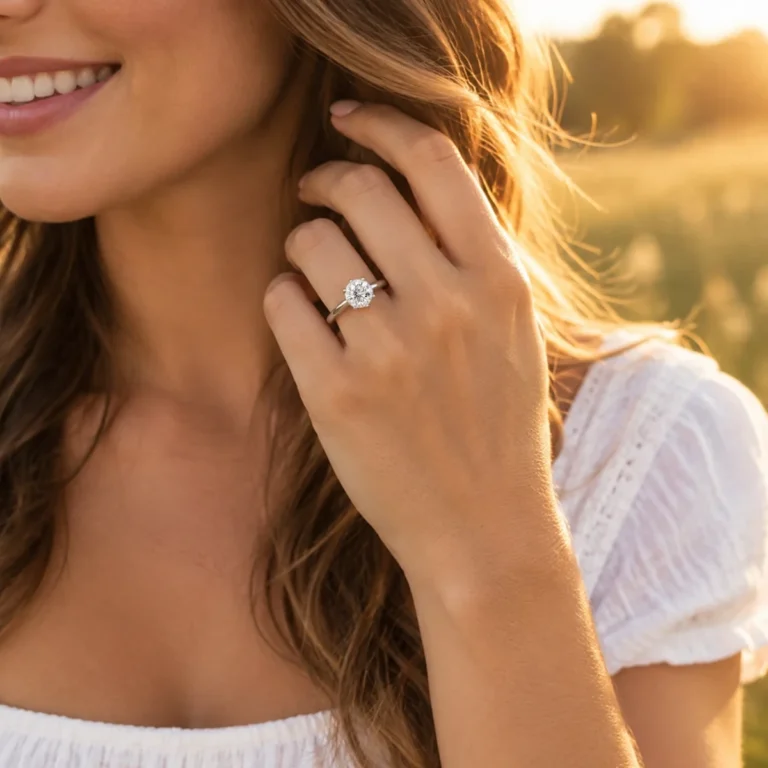
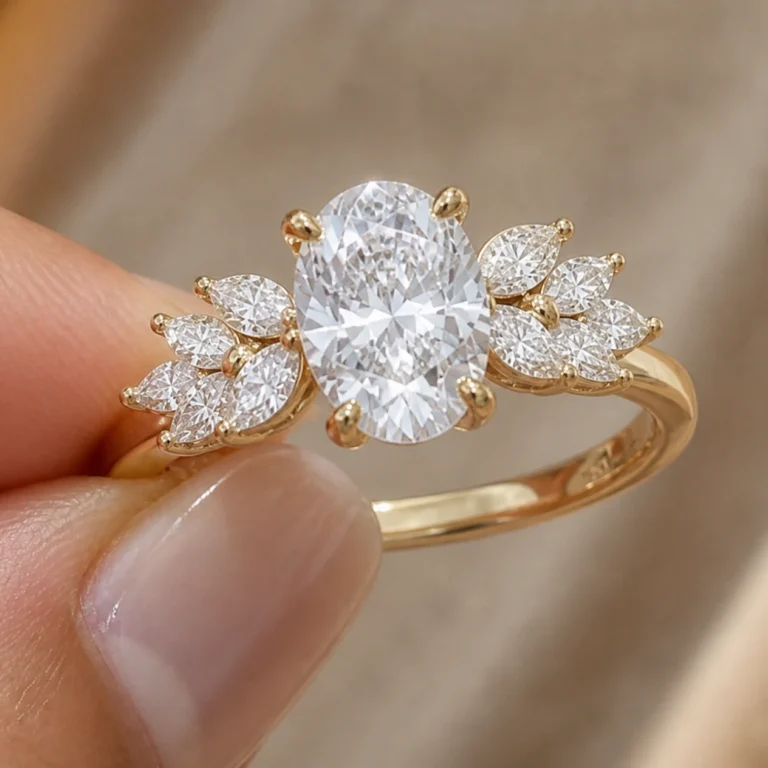
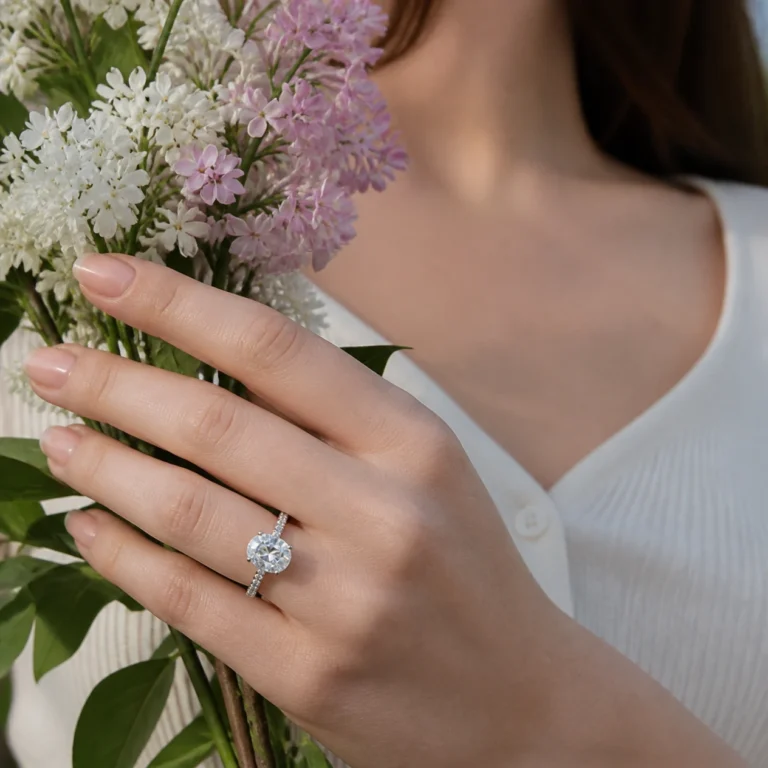
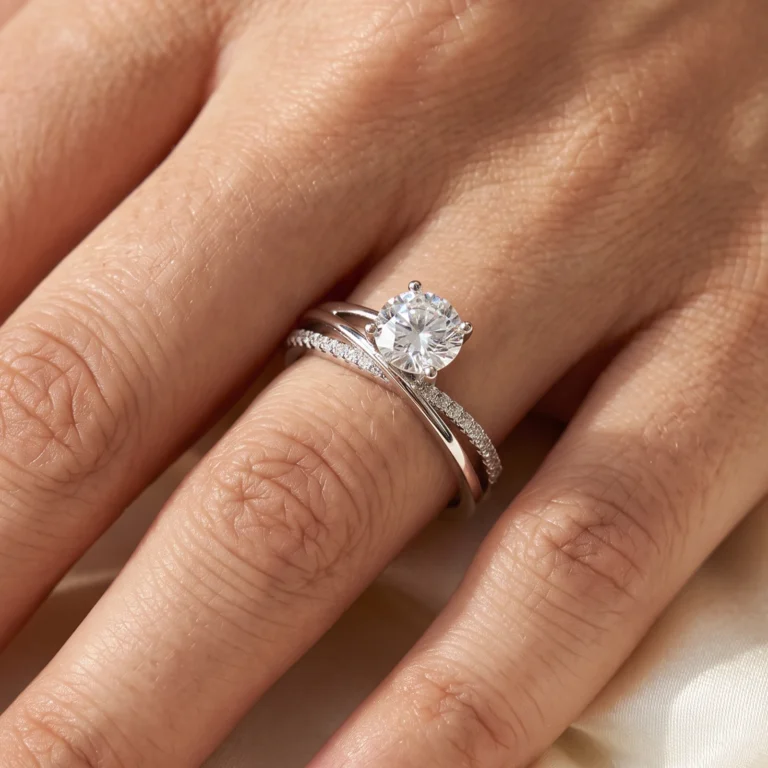
On each product page, you choose the stone, the weight, the metal and the ring size: the price of each version appears instantly. Another shape, another stone, an engraving? Write to us for a custom-made ring.
How to care for a solitaire ring
A stone attracts grease: cream, soap and fingers quickly dull it. To restore its sparkle, a bath of warm soapy water, a soft toothbrush passed under the stone, then drying with a soft cloth are enough. Take your ring off for sport, gardening, DIY and housework, and do not throw it in with other jewellery: a diamond scratches everything else, even gold. Once a year, have a jeweller check the prongs: a bent or worn prong can let the stone go. On white gold or rhodium-plated silver, fresh rhodium plating restores the metal’s full whiteness.
Frequently asked questions
What is the difference between a solitaire ring and an engagement ring?
Solitaire describes the design (a single stone), engagement ring describes the purpose. Most engagement rings are solitaires, but an engagement ring can also be a trilogy or a ring with side stones, and a solitaire can be worn without being an engagement ring.
Which finger is a solitaire ring worn on?
In France, the UK and the United States, the engagement ring is worn on the ring finger of the left hand, then with the wedding band, often above it. Customs vary: in Germany, for example, the wedding ring is worn on the right. A solitaire worn for yourself goes wherever you like.
How many carats for an engagement ring?
There is no standard: many solitaires are between 0.5 and 1 carat. The right weight depends on the hand (a 1-carat stone looks bigger on a slim finger), the style and the budget. For the same budget, lab-grown diamond and moissanite allow a larger stone.
Is a moissanite engagement ring a good idea?
Yes, if you love its sparkle. With a hardness of 9.25, moissanite copes very well with daily wear and keeps its brilliance for life. It is not a diamond: its rainbow flashes are stronger, especially in sunlight. Full comparison in our moissanite vs diamond guide.
Is a lab-grown diamond a real diamond?
Yes: it has the same composition (pure carbon), the same hardness and the same sparkle as a natural diamond; only its origin differs. It is certified like a natural diamond, with the word “laboratory-grown” on the certificate. Everything is explained in our lab-grown diamond guide.
How can I find out her ring size without her knowing?
Borrow a ring she wears on her ring finger and measure its inner diameter (multiply by 3.14 to get the French size), or slide it onto a ring sizer. You can also ask a friend or relative. As a last resort, choose an average size (52 to 54, about US 6 to 7) and a plain band that is easy to adjust.
Can you wear a solitaire ring every day?
Yes, with a diamond, a moissanite or a sapphire, sturdy prongs and a strong metal such as 14K or 18K gold or platinum. Simply take it off for manual work and sport, and have the prongs checked once a year. A low setting or a bezel catches less.
4 or 6 prongs: which to choose?
Six prongs hold the stone better and make it look rounder: the classic choice for a round solitaire. Four prongs show more of the stone and give a square, more modern outline, beautiful on an oval or a princess. Either way, what matters is the quality and upkeep of the prongs.
A custom-made project?
Size, quality, setting: let’s talk.