Black Friday, scratch to reveal your discount, up to 30% off, today only5% off 2 items | 10% off 3+ itemsFree shipping to EuropeCustomer service 7 days a week | Excellent Google reviews
Guides · 12 min
How to Choose Stud Earrings: Stone, Size, Metal and Back
How to choose stud earrings, the stone, the size in mm and carats, the setting, the metal for sensitive ears, the back so as not to lose them, and our advice for every occasion.
Simatta Bijoux · 24 November 2026
2 × 0.5 ct
A “1 carat” pair, the weight of both stones
5 mm
About 0.5 carat per stone in diamond
4
Prongs, the most common setting for studs
0.2 µg
Of nickel per cm² per week at most for a post (EU)
In short: stud earrings are discreet earrings that sit on the earlobe, with a stone or pearl fixed to a post and held behind the ear by a back. To choose them well, look at five points. The stone (natural diamond, lab-grown diamond, moissanite, sapphire, cubic zirconia or pearl), the size (from 3 mm, very discreet, to 7 mm and more for special occasions), the setting (4 prongs, 6 prongs, bezel or halo), the metal (solid gold, platinum, sterling silver, titanium) and the back (push back, screw back or Alpa). For sensitive ears, choose 18K gold, platinum, titanium or rhodium-plated sterling silver.
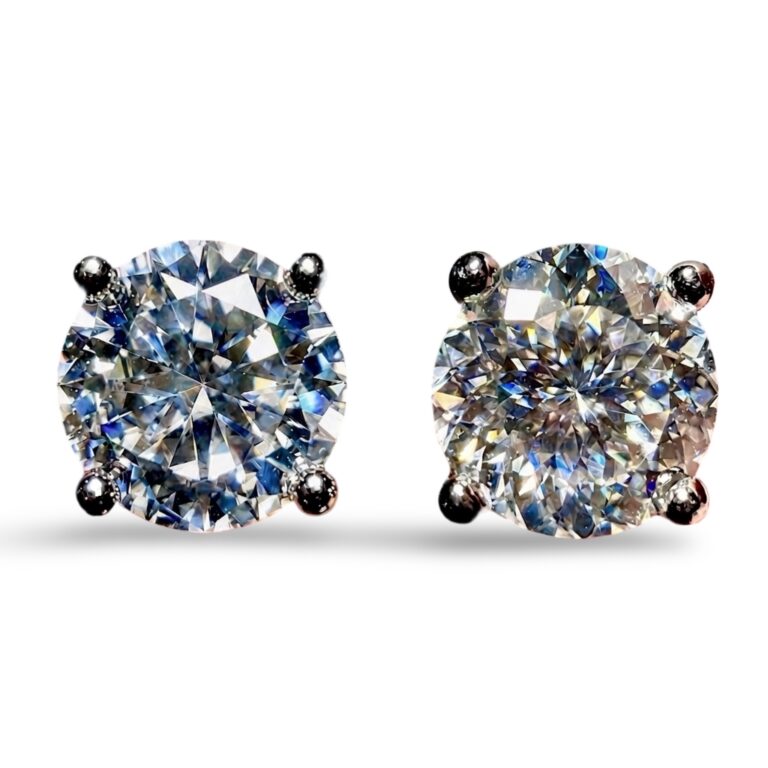
What are stud earrings?
A stud earring is an earring worn directly on the lobe, without dangling. It has three parts, the head (a stone, a pearl or a motif), the post that goes through the lobe, about 0.8 mm in diameter, and the back that holds it behind the ear. They are also simply called studs.
Stud earrings are the most worn earrings of all, because they go with everything. They suit office wear as well as an evening dress, all ages and all face shapes, and can be worn from morning to night without bother. The single-stone stud, often called a “solitaire stud”, is the most classic. There are also studs with a motif (flower, heart, star), halo studs surrounded by small stones, and pearl studs.
Which stone to choose for stud earrings?
On a stud earring, the stone can be seen from afar and catches the light with every movement of the head. Here are the most common white stones, compared with natural diamond:
Composition
Pure carbon, mined
Hardness (Mohs)
10
Sparkle
Very brilliant, balanced fire
Over time
Does not change
Certificate
GIA, IGI, HRD
Price (rough guide)
€€€€
Composition
Pure carbon, created in a laboratory
Hardness (Mohs)
10
Sparkle
Identical to natural diamond
Over time
Does not change
Certificate
IGI, GIA
Price (rough guide)
€€ to €€€
Composition
Silicon carbide, a gemstone in its own right
Hardness (Mohs)
9.25
Sparkle
More fire (rainbow flashes) than diamond
Over time
Does not change
Certificate
GRA, depending on the seller
Price (rough guide)
€€
Composition
Colourless corundum, natural or lab-grown
Hardness (Mohs)
9
Sparkle
Softer, less fire
Over time
Dulls quickly when dirty, easy to clean
Certificate
Rare
Price (rough guide)
€€
Composition
Crystallised zirconium oxide (synthetic)
Hardness (Mohs)
8 to 8.5
Sparkle
Brilliant at first, a lot of fire
Over time
Scratches and turns dull over the years
Certificate
None
Price (rough guide)
€
Natural diamond remains the benchmark, at the highest price. Lab-grown diamond has exactly the same composition, hardness and sparkle, for a much lower price. It is explained in detail in our lab-grown diamond guide. Moissanite is not a diamond, but it is almost as hard and even more sparkling, which makes it a very popular choice for large studs (see our comparison moissanite vs diamond). White sapphire is more understated. Cubic zirconia costs little but scratches and loses its sparkle. It suits fashion jewellery rather than studs worn every day for years.
Pearls are a family of their own. Freshwater cultured, Akoya or South Sea pearls bring a soft, nacreous lustre, very elegant, but they are delicate. No perfume or hairspray on them, and just a damp cloth to clean them. Coloured stones (blue sapphire, ruby, emerald, natural or lab-grown) give character to a pair of studs and go beautifully with yellow gold.
What size of stud earrings to choose?
The size of a stud earring is given by the diameter of the stone in millimetres, or by its weight in carats. Be careful, the weight stated for a pair is often the total weight of both stones. A “1 carat” pair therefore holds two stones of 0.5 carat, about 5 mm each. Guidelines for round brilliant-cut stones:
Discreet, for every day
About 0.10 to 0.25 carat per stone in diamond. A small point of light, ideal at work, for a second piercing or for a first pair.
The great classic
About 0.5 carat per stone, i.e. 1 carat for the pair. Clearly visible without being imposing, it is the most popular size for everyday studs.
A real presence
About 0.75 to 1 carat per stone. The stone can be seen from afar and catches the eye. A beautiful pair for a wedding or a memorable gift.
For special occasions
From about 1.25 carats per stone (8 mm, about 2 carats). Spectacular, these studs suit evenings and fairly wide lobes. A screw back or Alpa back is then recommended.
On the ear, a stone always looks smaller than on the table. If you hesitate between two sizes, the larger one is often the right one, except for a very thin lobe or studs worn in several piercings. Moissanite is a little lighter than diamond. At the same diameter it weighs about 10% less, which is why it is often sold in “diamond equivalent carats”. So always compare diameters in millimetres.
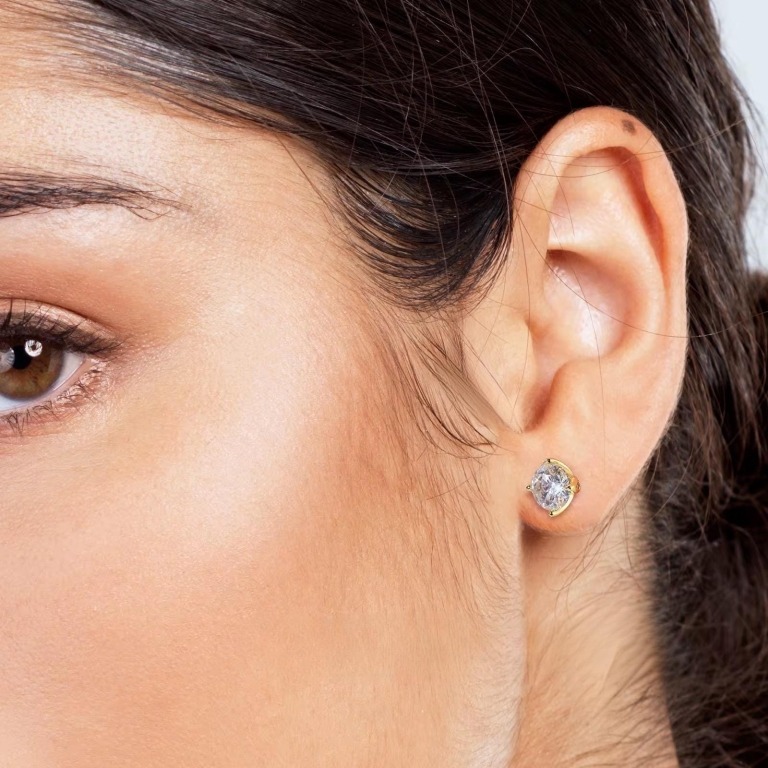
Which setting to choose for stud earrings?
The setting holds the stone and decides how much light passes through it. For stud earrings, the most common are the following:
4
4 prongs
The most widespread setting. The prongs show almost the whole stone and give it a slightly square outline. It is the most luminous.
6
6 prongs
A little more metal, a better-held stone and a rounder outline. A good choice for a large stone.
B
Bezel
A thin circle of metal surrounds the stone. Very secure, nothing catches (hair, jumper), but the stone receives a little less light and looks smaller.
H
Halo
A ring of small stones around the centre stone. It makes it look much larger and adds sparkle, for a gentler price than a single large stone.
Which metal to choose for stud earrings?
The metal touches the skin directly, inside the lobe. It matters as much for comfort as for colour:
The purest of jewellery golds
75% gold. Very well tolerated, it does not oxidise and keeps its colour. In white, yellow or rose gold. It is the safest choice for studs worn all the time.
Tougher, more affordable
58.5% and 37.5% gold. Harder than 18K gold, so less prone to scratches. They suit most skins. Our guide 9K, 14K or 18K gold compares the three.
The most resistant
Naturally white, dense and hypoallergenic. It holds prongs very well, but it is the most expensive metal.
The affordable precious metal
92.5% silver. Rhodium-plated, it becomes very white and hardly tarnishes. Gold-plated, it takes on the colour of gold. The differences are explained in our guide sterling silver, vermeil and gold plated.
For sport and small budgets
Light, strong and stainless. Implant-grade titanium is the best-tolerated metal of all. Steel suits most skins, but contains nickel.
For occasional wear
A layer of gold on another metal, often brass. The layer eventually wears off, and the metal underneath can irritate a sensitive lobe.
Stud earrings and sensitive ears
Itching, redness, a swollen lobe, a reaction to earrings most often comes from nickel, found in many cheap alloys. In Europe, the REACH regulation limits the amount of nickel an earring post may release (0.2 µg per cm² per week). The word “hypoallergenic”, on the other hand, has no legal definition, and each seller uses it in their own way. It is therefore better to look at the composition of the metal than at the label.
For sensitive ears, the best-tolerated metals are implant-grade titanium, 18K gold, platinum and rhodium-plated sterling silver. White gold is sometimes alloyed with nickel. If you have a known allergy, ask for palladium white gold. Avoid brass, fashion jewellery of unknown composition and very thin gold plating, which quickly reveals the metal underneath. For a new piercing, keep the jewellery fitted by the piercer until it has healed (often 6 to 8 weeks for the lobe) before switching to classic studs.
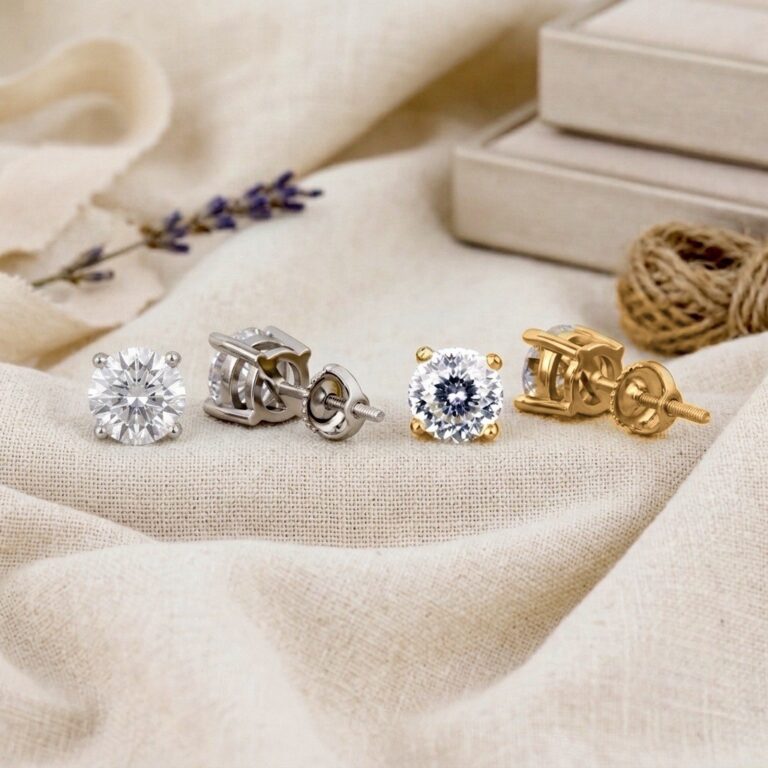
Which earring back to choose so as not to lose your studs?
The back is the detail people forget, and the one that loses the most earrings. The main systems:
P
Push back
The classic butterfly back, slid onto a smooth post and held by pressure. Simple and quick to put on, it loosens over time. Remember to tighten it slightly or replace it.
S
Screw back
The post is threaded and the back screws onto it. The most secure of all, ideal for valuable stones, heavy studs or children. It just takes a little longer to put on.
A
Alpa
A spring-loaded back that clicks into a small groove in the post. Very secure and easy to handle, it is found mainly on gold jewellery.
S
Silicone
A small soft disc, often added behind a metal back. It makes the hold firmer and more comfortable, but does not replace a safety back.
Our advice for every occasion
One pair of stud earrings cannot meet every wish. A few guidelines:
E
Every day
A 4 to 5 mm stone, in 4 prongs or a bezel, on solid gold or rhodium-plated silver, with a screw or Alpa back so you never have to think about it.
W
Wedding
6 to 7 mm, in lab-grown diamond or moissanite, or a white pearl. They go as well with the dress as with the engagement ring.
G
Gift
A 5 mm diameter pleases almost everyone. Choose the gold colour according to the jewellery already worn every day.
M
Men
A single stud or a pair, 4 to 6 mm, in a bezel or 4 prongs, in white gold, platinum or titanium. Black stones are also very popular.
S
Second or third piercing
Very small studs, 2 to 3 mm, to create a harmonious line with the main pair.
C
Child
A small stone in a bezel setting, nothing that catches, and a screw back.
How to care for stud earrings?
Stud earrings are worn so often that we forget to clean them. Yet sebum, cream and hairspray quickly dull the underside of the stone. Once a month, soak them for a few minutes in warm soapy water, gently brush the underside of the stone and the post with a soft toothbrush, then rinse and dry with a soft cloth. Clean the backs too, where dirt builds up.
Check from time to time that the prongs still hold the stone firmly and that the backs still grip. Put your studs on after perfume and hairspray, take them off for the swimming pool and sport, and store each pair separately so the stones do not scratch each other. To sleep in them, choose a screw or Alpa back, flatter and more secure.
Our stud earrings
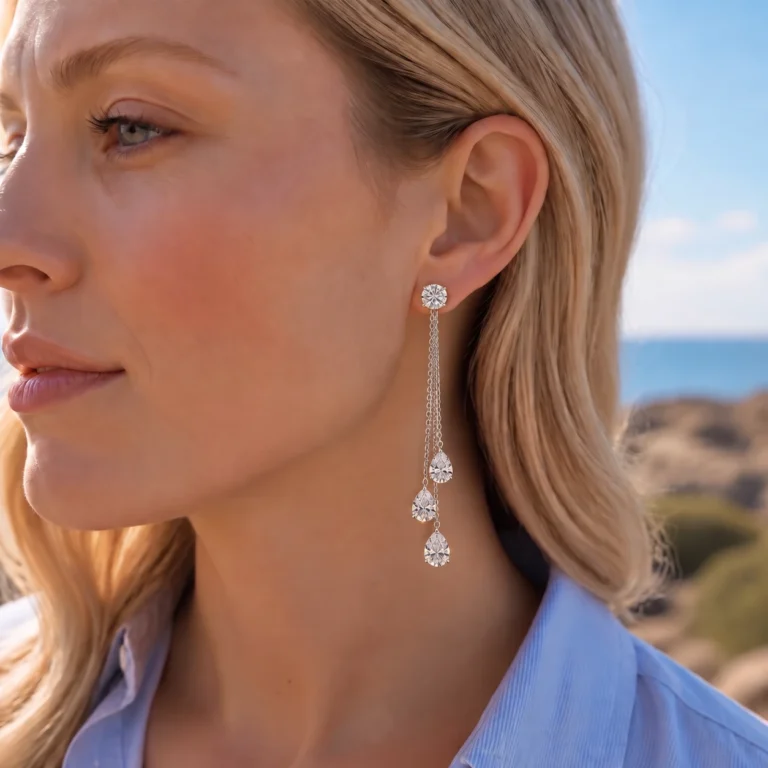
Another stone, another size, another back? Write to us for a custom-made creation.
Frequently asked questions
Are studs and stud earrings the same thing?
Yes, “studs” is simply the short name, it is the same jewel. A stone or motif sitting on the lobe, fixed to a post and held by a back. In French they are called “puces” or “clous d’oreilles”.
What size of stud earrings for every day?
Between 4 and 5 mm in diameter, i.e. about 0.25 to 0.5 carat per stone in diamond. Visible enough to sparkle, discreet enough for the office. For a second piercing, 2 to 3 mm is enough.
What size is a pair of 1 carat stud earrings?
Most often, “1 carat” means the total weight of the pair, i.e. two stones of 0.5 carat, about 5 mm each in brilliant cut. If each stone weighs 1 carat, it measures about 6.5 mm and the pair is 2 carats.
Moissanite or diamond for stud earrings?
Diamond, natural or lab-grown, is the hardest and most classic stone. Moissanite, a little less hard but more sparkling, allows large sizes for a gentler budget. On the ear, at a few dozen centimetres, both shine with a beautiful white sparkle.
Can you sleep in stud earrings?
Yes, with flat studs and a screw or Alpa back, which does not come undone and presses less on the neck. Avoid sleeping in large stones in high prongs or in pearls, which are more delicate.
Can you shower with stud earrings?
Studs in solid gold, platinum or titanium are not afraid of water. Better to take off silver, gold plated and pearls, which soap, limescale and chlorine dull. And always rinse off the soap left under the stone.
How not to lose a stud earring?
Choose a screw or Alpa back, check regularly that the backs still grip and replace them as soon as they slip. A silicone back added behind improves the hold of a push back.
Which stud earrings for sensitive ears?
Studs in implant-grade titanium, 18K gold, platinum or rhodium-plated sterling silver. Avoid brass, fashion jewellery and thin gold plating. If you are allergic to nickel, ask for nickel-free white gold.
Are stud earrings suitable for men?
Yes, they are even the earrings men wear most. A 4 to 6 mm stone in a bezel or prongs, in white gold, platinum or titanium, worn in one ear or both.
A custom-made project?
Size, quality, setting: let’s talk.